CEO and CFO visibility should not communicate the same visual signal.
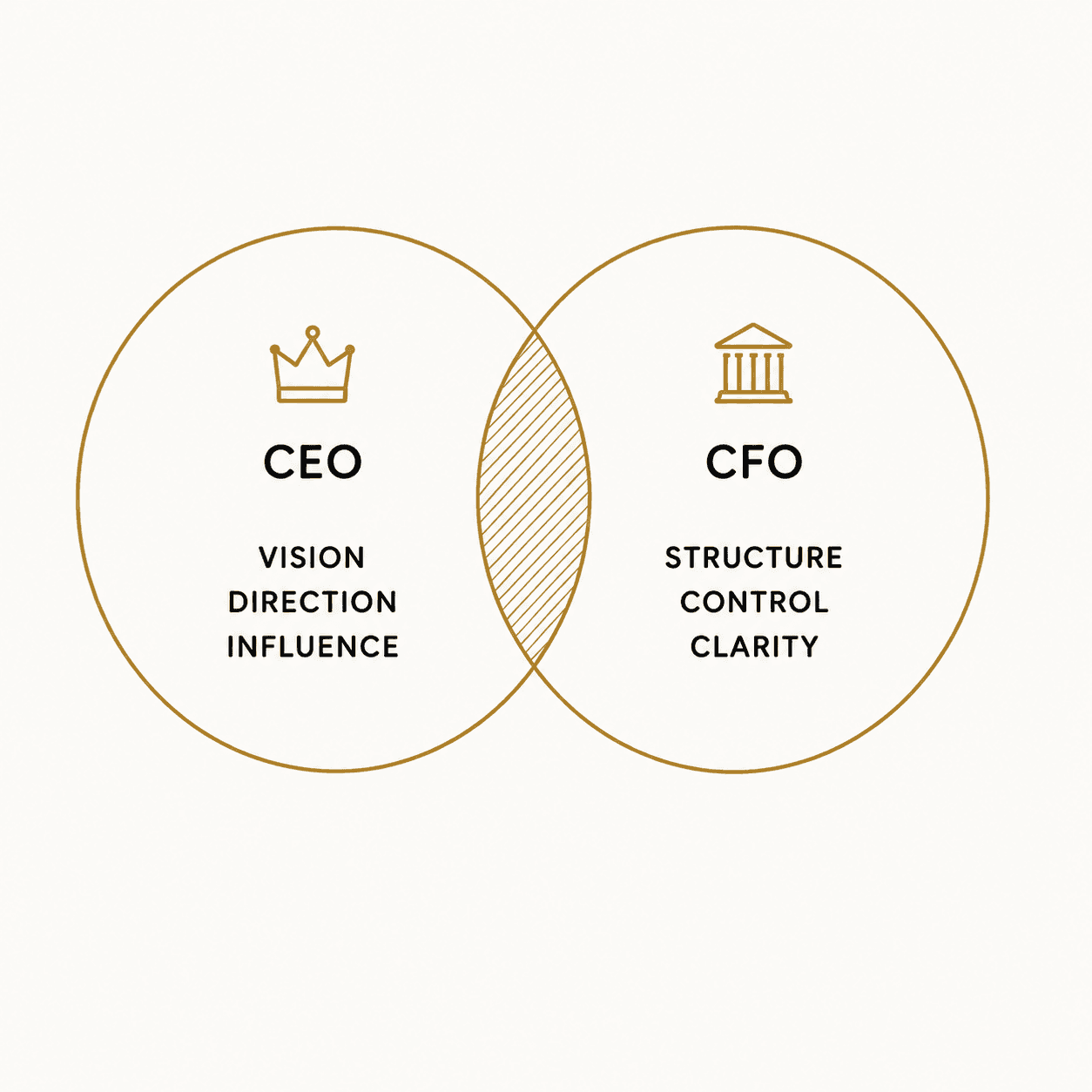
Executive Visibility Requires Alignment Without Sameness
Many organizations mistake consistency for sameness. They standardize executive visibility until leadership distinction disappears. The result may look orderly, but it can weaken perception immediately.
A CEO and CFO are not expected to communicate the same type of authority. One may signal expansion, narrative and external direction. The other may signal control, discipline and structural confidence. Both require trust, but they require different forms of trust. When executive visibility systems flatten these distinctions, leadership hierarchy becomes harder to interpret.
At executive level, the objective is not to make every leader appear identical. The objective is to make leadership feel coordinated, clear and properly defined. Strong executive teams are not visually interchangeable. They are strategically aligned.
Consistency Should Not Remove Role Intelligence
Consistency is valuable when it creates trust. It becomes limiting when it removes role intelligence. A leadership team should share a visual standard, but each leader should still communicate the authority appropriate to their role, function and level of responsibility.
A founder may need to carry vision and institutional origin. A CEO may need to carry direction and market confidence. A CFO may need to carry discipline and control. A board member may need to carry stewardship and governance. These signals should not compete, but they should not collapse into one generic executive treatment either.
When every leader is presented with the same visual weight, the audience has to work harder to interpret the leadership system. That extra effort creates friction. The page may appear professional, but it does not necessarily help stakeholders understand who carries which kind of authority.
Role Distinction Strengthens Trust
Trust is not created by uniform presentation alone. It is created when the audience can quickly understand the structure of leadership. Role distinction helps stakeholders interpret who leads, who governs, who represents stability and who carries future direction.
This does not require obvious hierarchy or exaggerated status. It requires controlled differentiation. The visual system should make distinctions visible without making them loud. The difference between roles can be communicated through sequencing, scale, image treatment, tone, biography structure and platform context.
When role distinction is governed well, the leadership system becomes easier to read. Each executive feels properly positioned. The organization feels more mature because its leadership structure appears intentional.
Flattened Leadership Signals Create Ambiguity
The issue with visual sameness is subtle but consequential. Stakeholders may not consciously identify the problem, yet they instinctively feel a lack of leadership definition. If the CEO, CFO, founder, board member and functional executive all carry the same signal, the structure of authority becomes less clear.
This can make a capable leadership team feel less strategic than it is. It can make a mature organization feel visually under-governed. It can create the impression that leadership visibility was collected rather than structured.
At senior level, ambiguity weakens confidence. The audience should not have to search for leadership hierarchy. They should feel it through the page, the system and the way each executive is positioned.
Alignment Requires Controlled Differentiation
Governed executive visibility operates through controlled differentiation. Every leadership role communicates a distinct authority category while remaining part of one unified system. The standard holds, but the role signal changes.
This means shared standards without duplication, cohesion without visual flattening and alignment without sacrificing role intelligence. The purpose is not to create visual variety for its own sake. The purpose is to make the leadership system more legible.
A well-governed executive visibility system knows where leaders should feel connected and where they should feel distinct. It understands that trust depends on both unity and clarity.
Executive Visibility Is Organizational Clarity
This is not simply branding language. It is organizational clarity. The way leaders are presented affects how quickly stakeholders understand the company’s structure, maturity and authority.
In executive environments, perception is not only about professionalism. It is about interpretive precision. The audience should know what kind of leadership they are looking at before they need it explained.
Leadership that is immediately understood is leadership that is trusted faster. This is why executive visibility should be aligned, but never flattened. The strongest systems create a shared standard while preserving the intelligence of each role.