Trust Is Built Before It Is Asked For.
Trust Is Built Before It Is Asked For.
Trust is often discussed as a value, but in leadership communication, it is also a signal. It is shaped before a formal meeting, before a proposal is reviewed and before a stakeholder has time to study every credential in detail.
The question is not simply whether a company wants to be trusted. Every company does. The more important question is whether leadership presence gives stakeholders enough confidence to begin trusting what the company says about itself.
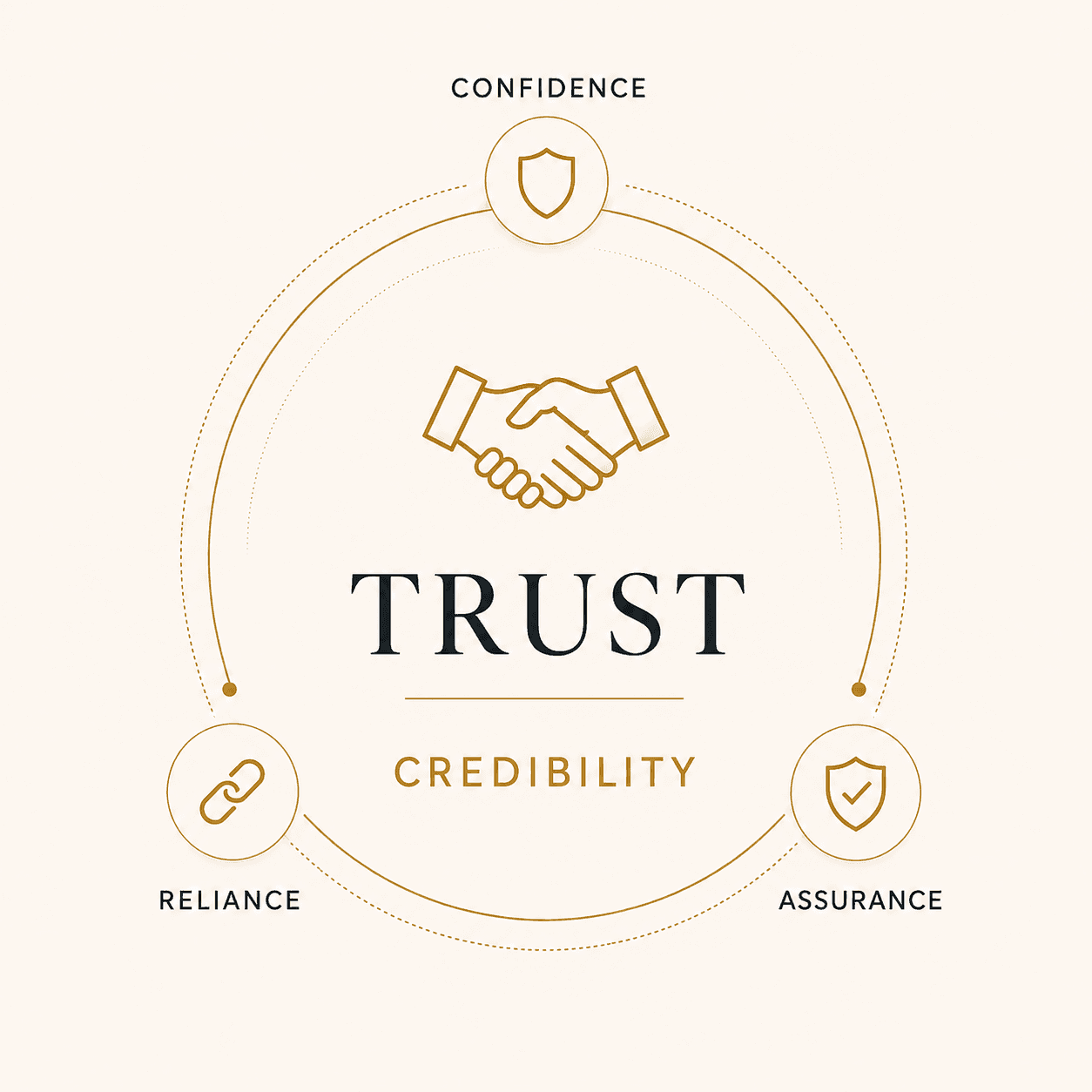
Trust does not begin with visibility. It begins when credibility has been established and leadership signals remain clear enough to be believed.
Trust Follows Credibility
Credibility is the first threshold. Trust is what can follow when that threshold is met.
A stakeholder may first ask whether the company appears serious, capable and coherent. Once that initial credibility is present, the deeper question becomes whether the leadership system feels reliable enough to trust. Does the company appear stable? Does leadership feel clear? Does the visible standard match the responsibility the organization carries?
This is why trust cannot be forced by stronger language, more content or more visibility. A leadership page can say all the right things and still create doubt if the signals around leadership feel uneven. It can present accomplished executives and still weaken trust if the page appears assembled rather than governed.
Trust forms when the audience does not have to work too hard to believe the company.
Trust Is Reinforced Through Repeated Signals
Trust is not built from one strong appearance. It is reinforced through repeated signals that confirm the same standard over time.
The way leadership appears on a company website, in investor materials, across media moments and on public platforms should not feel disconnected. Stakeholders may not study each visibility point in detail, but they absorb the pattern. They notice whether leadership feels stable, whether the company feels composed and whether the visible signals support the same standard.
When leadership visibility shifts too frequently, visually, tonally or structurally, confidence weakens quietly. The leader may still appear credible in each individual setting, but the overall signal begins to lose control.
At executive level, trust is affected by continuity.
The Page Is a Trust Environment
A leadership page is not only a place where people learn who leads. It is a setting where trust is either supported or weakened.
Investors look for maturity. Boards look for structure. Partners look for reliability. Employees look for stability. Senior candidates look for seriousness. Media and market observers look for coherence. These audiences may have different priorities, but they all read leadership signals quickly.
Image treatment, role order, hierarchy, tone, biography length, visual consistency and restraint all contribute to whether the page feels dependable. None of these elements alone creates trust. Together, they create an environment where trust becomes easier to form.
This is the difference between a page that is merely professional and a page that is governed.
Professional can still be uneven. Governed means the company has made deliberate decisions about how leadership should be understood.
Unmanaged Visibility Creates Doubt
Trust is fragile when leadership presence appears assembled from separate choices.
A casual image beside a formal one. A dense biography beside a restrained one. A founder presented with unclear hierarchy. A CFO visually treated the same as a role with a different level of responsibility. A board section that feels disconnected from the executive team. None of these issues may seem severe on its own, but together they create friction.
The audience may not articulate the problem, but they feel the lack of standard. The company begins to feel less composed. Leadership may still be visible, but visibility alone does not create trust.
At executive level, inconsistency is not only a design issue. It is a confidence issue.
Governed Presence Reduces Friction
The strongest leadership pages do not perform trust. They reduce doubt.
They use restraint instead of excess. They make hierarchy visible without making it aggressive. They clarify responsibility without overexplaining authority. They create enough consistency for the leadership system to feel controlled, while allowing each role to carry its proper weight.
This is where Executive Visual Governance becomes important. It gives leadership presence the structure required for trust to form. It aligns the visible signals of leadership so the audience can understand the company with less friction.
Governance does not make leadership louder. It makes leadership clearer.
It ensures that the page reflects the company’s maturity, role structure and standard of responsibility. It protects the company from unmanaged visibility, where every executive appears according to individual preference rather than one leadership standard.
Trust Is Earned Quietly
Trust is rarely created by one dramatic signal. More often, it is earned through repeated quiet indicators: credibility, role clarity, visual discipline, aligned tone, controlled hierarchy and the absence of avoidable doubt.
When those indicators work together, the company becomes easier to trust. The audience understands what they are seeing. The leadership system feels coherent. The organization appears more stable, more considered and more capable of carrying responsibility.
That is the commercial value of governed leadership presence. It helps trust form before the first conversation begins, so the company is not starting from uncertainty.
A leadership page cannot ask stakeholders to trust what it has not made credible. It has to create the conditions for trust through structure.
Because stakeholders are not only reading what leaders have done.
They are reading whether leadership can be trusted with what comes next

